Can Your HOA Ban Solar Panels in New Jersey?
Understanding NJ Solar Rights

Navigating the rules of a Homeowners Association (HOA) can feel like a full-time job, especially when you are trying to make sustainable upgrades to your home. If you live in New Jersey, you may have heard conflicting information about whether your HOA can legally stop you from “going green.”
At SunnyMac, we believe in providing stability and clarity for your home’s energy future. As the region’s trusted energy expert, we want to ensure you know exactly where you stand regarding the New Jersey Solar Rights Act.
The Short Answer: No, Your HOA Cannot Ban Solar
In New Jersey, the law is on the side of the homeowner. Under N.J.S.A. 45:22A-48.2, homeowners associations are generally prohibited from adopting or enforcing rules that outright ban the installation of solar collectors.
Whether you live in a single-family home or a townhouse where you own the roof, your right to produce clean, sustainable energy is protected by state law.
How the NJ Solar Rights Act Protects You
The New Jersey Solar Rights Act (and subsequent updates like the 2026 Homeowners’ Energy Policy Act) ensures that associations cannot use “aesthetic concerns” as a loophole to prevent energy independence.
1. Prohibiting Absolute Bans
Your HOA cannot pass a bylaw or covenant that stops you from installing solar on a roof you solely own. This applies to most single-family homes and many townhomes within common-interest communities.
2. The “10% Rule” for Cost and Efficiency
While an HOA can suggest “reasonable” restrictions, such as where on the roof the panels are placed, those restrictions are invalid if they:
- Increase the cost of the installation or maintenance by more than 10%.
- Inhibit the solar system from functioning at its intended maximum efficiency.
3. New 2026 Requirements for Associations
As of April 1, 2026, all condominium and subdivision associations in New Jersey must adopt a written policy regarding the rights of members to install solar energy systems. If an association fails to provide this written policy, they lose significant authority to regulate your installation, giving homeowners even greater freedom to move forward.
Reasonable vs. Unreasonable HOA Restrictions
While they cannot ban solar, HOAs are still permitted to enforce “reasonable” guidelines to maintain community standards.
| What HOA CAN do | What HOA CANNOT Do |
|---|---|
| Require a licensed professional for installation. | Require placement that reduces energy output by over 10%. |
| Ask to see your engineering plans and specifications. | Charge “aesthetic fees” that make the project unaffordable. |
| Request that wiring or piping be concealed where possible. | Demand the panels be moved to a shaded side of the house. |
| Require panels to be flush-mounted or low-profile. | Force you to use a specific, high-cost brand of panels. |
SunnyMac is NABCEP certified and a SolarEdge Preferred Partner. We handle the technical documentation your HOA needs to see, ensuring your proposal meets both state law and community standards.
2026 Financial Landscape: The Shift to PPAs
A major change occurred in 2025 regarding how New Jersey residents fund their solar projects. The 30% Federal Tax Credit is no longer directly available to homeowners who purchase their systems outright but that doesn’t mean there are no financial incentives for solar in new jersey.
You can still indirectly benefit from this incentive through a Power Purchase Agreement (PPA) or a Lease.
- How it Works: Financial institutions (the system owners) claim the tax credit and pass the savings on to you in the form of a significantly lower electricity rate.
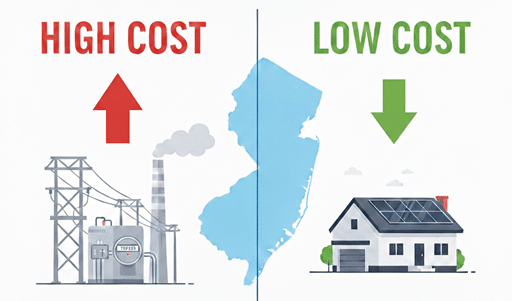
- The Benefit: In New Jersey, PPA rates remain well below standard utility rates. This allows you to gain energy stability and immediate monthly savings with zero upfront costs..
NewStep-by-Step: Getting HOA Approval in NJ
Working with your HOA doesn’t have to be a battle. We recommend a “Service with Integrity” approach:
- Check Your Governing Documents: Look for the Covenants, Conditions, and Restrictions (CC&Rs) to see existing solar guidelines.
- Request the Written Energy Policy: Since the 2026 deadline, your HOA must have a specific solar policy available.
- Submit a Detailed Proposal: Include professional site plans and hardware specs. SunnyMac provides these as part of our comprehensive service and depending on the HOA we may be able to submit them for you.
Cite the Law if Needed: If your board pushes back on placement, remind them of the 10% cost/efficiency protection under N.J.S.A. 45:22A-48.2.
Homeowners who trusted SunnyMac
Essential Resources for New Jersey Solar Energy

Is Solar Worth It in New Jersey?
While the 2026 elimination of the 30% direct federal tax credit has changed the landscape, solar remains a powerful investment in New Jersey through the indirect savings of Power Purchase Agreements (PPAs). By partnering with financial institutions that claim the credit, SunnyMac provides homeowners with stable electricity rates that sit well below the rising costs of traditional utilities. Combined with state incentives like SREC-II and 1:1 net metering, our holistic energy solutions ensure long-term comfort and financial resilience for Garden State families.
NJ Net Metering & Electric Bills Explained
New Jersey’s 1-to-1 net metering program serves as a critical financial engine for homeowners, allowing the local electric grid to function as a “free battery” by banking excess daytime solar energy for later use. This system ensures you receive full retail credit for every kilowatt-hour exported, effectively offsetting usage charges and providing stability against seasonal production dips. To maximize these benefits, SunnyMac recommends strategically setting an April “True-Up” date to prevent summer credits from being prematurely reset before the higher-demand winter months.
The 2026 Guide to NJ Solar Incentives
n 2026, New Jersey’s solar landscape has shifted toward Power Purchase Agreements (PPAs) following the elimination of the 30% direct federal tax credit for homeowners who purchase systems. While residents can no longer personally claim the credit, they capture its value indirectly through SunnyMac’s financial partners, who apply the tax savings to provide electricity rates well below those of local utilities. This strategy, combined with 1:1 net metering and the SREC-II program, ensures that New Jersey remains a premier state for achieving long-term energy stability and cost protection.
Your Trusted Solar Partner in New Jersey
New Jersey homeowners are taking control of their energy costs and paving the way for a cleaner future. With robust state incentives and abundant sunshine, the Garden State is one of the best places in America to go solar.
At SunnyMac, we provide the stability and expertise you need to make the switch with confidence. We’re not just a solar installer; we are your long-term partner, committed to providing end-to-end service and a seamless, transparent experience. From the first consultation in your home, whether in Cherry Hill, Princeton, or anywhere across the state, to the final installation, our team is dedicated to finding the perfect solar solution for your family.
The SunnyMac DifferFAQs: NJ Solar & HOAs
Can my HOA make me install panels on the back of my house?
Only if the back of the house receives enough sun to maintain maximum efficiency. If moving them to the back reduces your production by more than 10%, the HOA cannot legally force that change.
What if my HOA hasn’t updated its rules by the April 2026 deadline?
If the association fails to adopt a written energy policy by April 1, 2026, they may lose their right to prohibit your installation or enforce existing restrictive covenants.
Does solar increase my property taxes in New Jersey?
No. New Jersey offers a Property Tax Exemption for the added value of a solar system. While solar increases your home’s market value, your tax assessment remains the same.
Do I still save money without the 30% direct tax credit?
Yes. Through a PPA, the financial provider claims the credit and offers you a lower fixed rate for electricity, protecting you from rising utility costs. Learn more here.
The SunnyMac Difference
At SunnyMac, we don’t just install panels; we manage the entire energy story of your home. From navigating HOA red tape to ensuring your roof is “solar-ready,” our specialists are here to provide a stable, ethical partnership.
We have helped thousands of homeowners in New Jersey, Pennsylvania, Maryland, and Delaware achieve energy independence while respecting community standards.
Get Your Free Savings Analysis
