Battery storage
Solar panels generate electricity when sufficient sunlight is available. A home battery can store some of that electricity for later use, including in the evening or during an outage when the equipment is configured to provide backup power.
Ranked #5 in the country for residential solar by Solar Power World, 2026. See our awards and credentials

A home battery can serve different purposes, including providing backup power during outages and storing electricity for use later. Whether it offers financial benefits depends on your utility rates, applicable programs, equipment, and how the battery is used.
If backup power is your goal, size it to what you need running during an outage — the fridge, the well pump, a few circuits — rather than to the whole house.
Should I size a battery for backup or for evening use?
These are different goals. Backup sizing is about which circuits you want running during an outage. Self-consumption sizing is about your evening load. They lead to different batteries.
Already planning or preparing for installation?
If a battery is already part of your project, this is what the installation and the first outage look like.
What’s the difference between essential-load and whole-home backup?
These are different designs. Essential backup powers selected circuits — the fridge, lighting, outlets, internet equipment. Whole-home backup is designed to carry most or all of the house including HVAC and larger appliances, depending on battery capacity and system design. Your plan reflects one of these, and it is a decision made with you rather than a default.
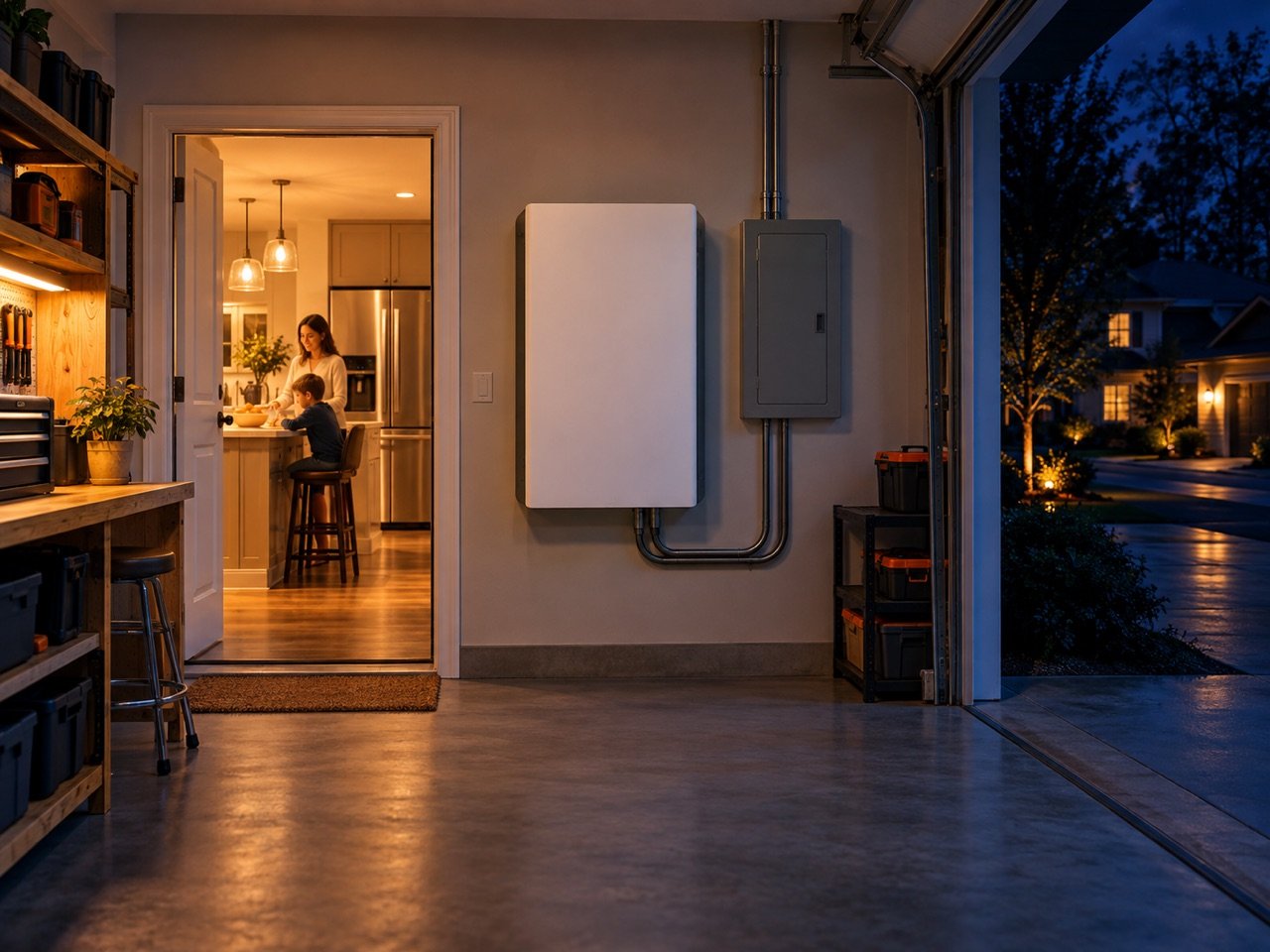
Installation day
- The installation team reviews the planned work with you before beginning.
- Depending on the equipment and electrical work involved, installation may require a temporary interruption of power.
- The battery is installed, connected, tested, and commissioned according to the project plan.
- Monitoring is configured as applicable, and the team explains how to use and monitor your battery before the installation process is complete.
What happens to my battery during a power outage?
- Backup operation. If your battery installation includes backup capability, the equipment may automatically supply power during an outage, depending on the installed configuration.
- Transfer to backup power. You may notice a brief interruption or flicker when backup power activates. What happens depends on the equipment and system design.
- What stays powered. Only the circuits or loads included in your backup design will receive backup power.
- How long backup lasts. Battery capacity, available charge, and electricity use affect backup duration. Running several large appliances at once can shorten the time power remains available.
Operating modes
Depending on the equipment installed and your utility's rate structure, a battery may be able to run in different modes — reserved for outages only, storing solar during the day to power the house at night, or charging and discharging around time-of-use pricing where your utility offers it. Which modes are available depends on the battery, and some manufacturers offer automatic weather-based reserving under their own product names. Your installation plan states what your system does.
What is a backup reserve?
Backup-reserve settings depend on the battery, operating mode, homeowner priorities and expected weather. Your SunnyMac advisor will review the appropriate setting for the equipment installed at your home.
Monitoring and maintenance
Home batteries generally require limited routine maintenance, although monitoring, software updates, and maintenance requirements depend on the equipment installed. Keep the area around the battery clear, check performance in the app, and talk to us before changing any backed-up circuits.
What decides this
- How often your power goes out, and for how long. Worth checking rather than assuming.
- What genuinely has to keep running. A medical device or a well pump is a different question from convenience.
- Your utility rates and applicable programs. These can affect whether storing electricity for later use offers a financial benefit.
- Whether you want it now or later. Some inverters accept a battery added afterwards; some do not, and that is a decision made at design.
How this works where you are
Utility rates, net metering arrangements, available programs, and battery operating options can vary by location. Those details can affect whether battery storage is most useful for backup power, using stored electricity later, or a combination of goals.
Download the Home Battery Installation and Education Guide (PDF, 85 KB)
About SunnyMac
2009
the year SunnyMac was founded
3 offices
Marlton NJ, Bethlehem PA and Wilmington DE
4 states
New Jersey, Pennsylvania, Delaware and Maryland
4.6
out of 5 on Google, based on 669 reviews · As of October 6, 2026 · Read our Google reviews (opens in a new tab)
We stay with what we build. SunnyMac is a home electrification, roofing and HVAC company specializing in solar, battery storage, roofing, and heating and cooling, with a mission to make every home we touch more comfortable, more resilient and cheaper to run, proudly serving communities in NJ, PA, MD and DE since 2009.
Also worth reading
Cost and financing
Cash, loan and lease compared honestly.
Roof and solar together
How roof condition can affect solar planning and the order of work.
EV charging
Level 2 charging, what the panel has to support, and what the run to the parking spot costs.
Service for existing systems
Including orphaned systems where the original installer is gone. You do not need to have bought from us.
Panel removal and reinstallation
What it involves, why it costs what it does, and how to avoid needing it at all.
Installation and project preparation
What installation day, electrical upgrades, meter changes, and site work can involve.
Reading your utility bill after solar
What the numbers mean, and why the bill rarely reaches zero.
How home solar works
Panels, inverter, meter, and what the utility does with the difference.
Solar equipment choices, explained
Microinverters, optimizers and string inverters — what differs.