Solar GuidesService for existing systems
We service solar systems we did not install
If your installer has closed, been acquired, or simply stopped answering, your system has not stopped being serviceable. It is a common situation and a fixable one.
Ranked #5 in the country for residential solar by Solar Power World, 2026. See our awards and credentials
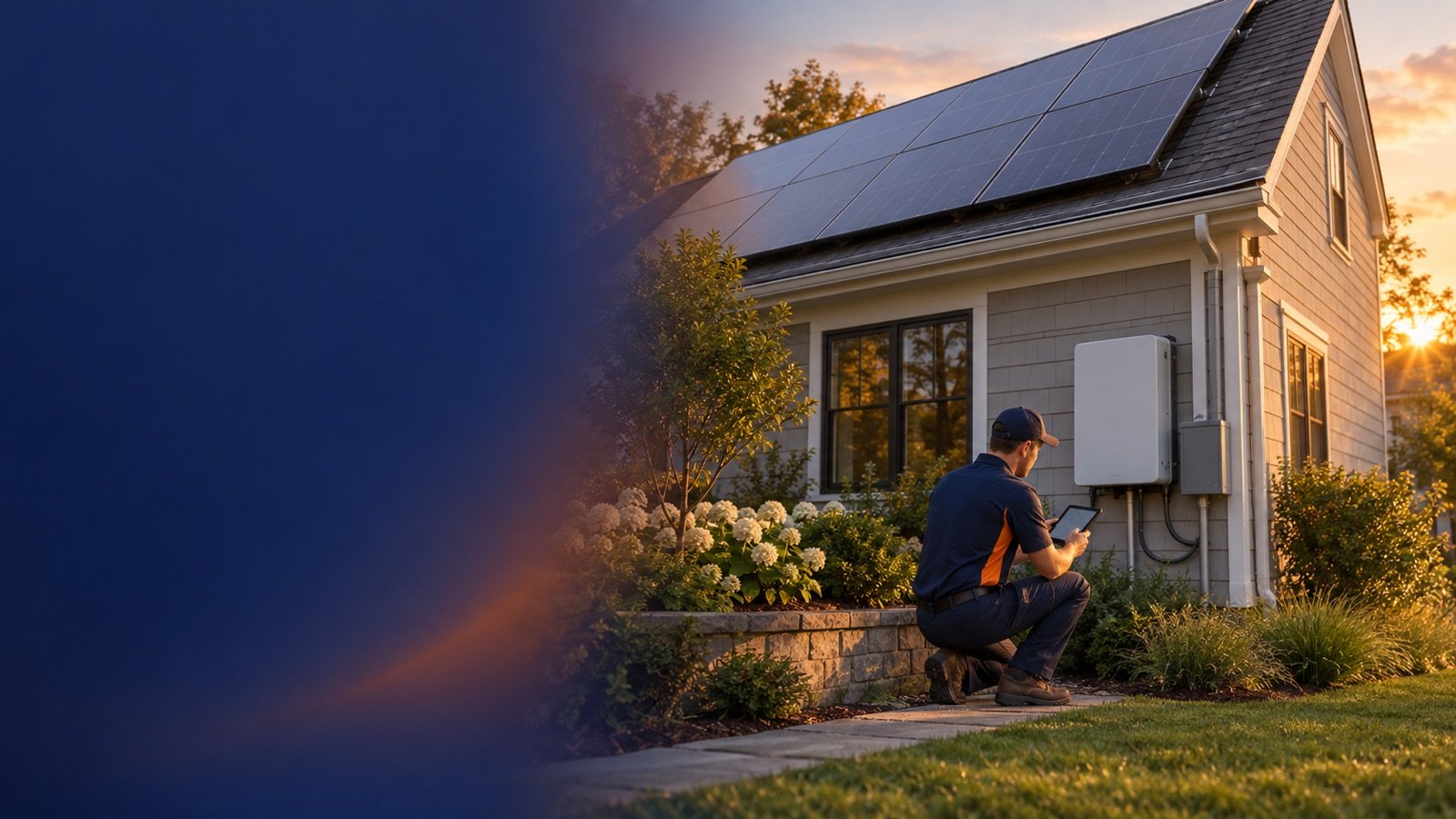
We service systems we did not install. You do not need to have purchased your original system from SunnyMac. If the company that installed yours has gone, your panels have not stopped working — but nobody is monitoring them, and a system can under-produce for years without anything obvious happening. The first step is finding out what it is generating against what it should.
Orphaned systems
A lot of solar sold in this region over the last fifteen years was installed by companies that no longer exist. When that happens the equipment is usually fine — what is lost is the relationship: monitoring logins, paperwork, and anyone who will take the call.
We take those systems on. That means diagnosing what is wrong rather than assuming, and getting monitoring working again so you can see production.
Our team will review what you’ve told us and contact you to arrange the next step. An inspection or visit may follow; submitting this request does not book one.
What we handle
- Production has dropped or stopped, and nobody can tell you why
- Inverter faults and replacements, including obsolete models
- Monitoring you have lost access to
- Panels needing removal and reinstallation for a reroof
- Physical damage, animal intrusion under the array, and loose mounting
- Annual maintenance for people who would rather not wait for a fault
My system is producing less than it used to. What is wrong?
Usually one of five things, and they are worth ruling out in this order because the cost of checking rises as you go down the list:
- Nothing. Compare against the same month last year, not against last month. Seasonal variation is large and completely normal.
- New shade. Trees grew. This is the most commonly missed cause, because it happens too slowly to notice.
- One panel or one string. On a system with per-panel hardware this is visible in monitoring. On a plain string inverter it is not, and it needs measuring at the array.
- The inverter. Inverters are the shortest-lived major component and can fail partially rather than completely, which produces exactly this symptom.
- Soiling or something physical. Bird mess, a nest under the array, a shifted panel.
What we do first is compare actual generation against what the system should produce for its size, orientation and the weather it has had. Without that comparison, any diagnosis is a guess — including ours.
Do solar panels need cleaning?
Less often than most people expect, in this climate. Rain does most of the work, and panels are installed at a pitch that helps it run off. Routine cleaning on a schedule is rarely what restores lost production.
It is worth doing when something is sitting on the glass: bird mess, sap or pollen that has baked on, construction dust, or ash. If production has dropped and the panels look clean, cleaning them will not fix it and the list above is the better place to start.
We do not publish a figure for how much dirt costs you in output, because we have no measurement for these four states and the numbers quoted around the industry come from much dustier places than the Mid-Atlantic.
What about animals under the panels?
The gap between the panels and the roof is sheltered, dry and warm, which makes it attractive to squirrels and to nesting birds. Two things go wrong: droppings and nesting material shade the panels and hold moisture against the roof, and squirrels chew wiring, which is both a production problem and a fire risk.
The fix is mesh around the array perimeter, fitted so it does not trap water or damage the roof surface. Worth doing after the space has been cleared rather than sealing anything in.
If you can hear activity above the ceiling near the array, or you are finding debris on the ground below it, that is worth a look before it becomes a wiring repair.
What should I check each season?
Very little, and none of it involves going on the roof:
- Spring. Check production against last spring. Look for nesting starting under the array.
- Summer. Peak production, so it is the best time to notice a panel or string that is not contributing. Heat reduces output slightly — that is expected, not a fault.
- Fall. Clear leaves from the roof and gutters. Leaves on the array itself matter less than leaves holding water against the roof under it.
- Winter. Expect much lower output. Snow slides off a pitched array on its own and clearing it by hand risks scratching the glass and hurting yourself for a day or two of production.
The single most useful habit is looking at monitoring once a month. A fault caught in a month costs a month of generation; the same fault caught at the annual true-up costs a year.
Why we do this when many installers will not
Service work is unglamorous and does not sell a new system. But a region full of orphaned arrays is bad for solar generally, and the households involved were sold something on a promise nobody kept. We would rather be the company that picks it up.
What decides this
- Whether it is producing what it should. Measurable, and the only honest starting point.
- Whether monitoring still works. Frequently the only thing that has failed.
- Inverter age. Inverters do not last as long as panels, and are the usual first replacement.
About SunnyMac
2009
the year SunnyMac was founded
3 offices
Marlton NJ, Bethlehem PA and Wilmington DE
4 states
New Jersey, Pennsylvania, Delaware and Maryland
4.6
out of 5 on Google, based on 669 reviews · As of October 6, 2026 · Read our Google reviews (opens in a new tab)
We stay with what we build. SunnyMac is a home electrification, roofing and HVAC company specializing in solar, battery storage, roofing, and heating and cooling, with a mission to make every home we touch more comfortable, more resilient and cheaper to run, proudly serving communities in NJ, PA, MD and DE since 2009.
Also worth reading
Cost and financing
Cash, loan and lease compared honestly.
Roof and solar together
How roof condition can affect solar planning and the order of work.
Battery storage
What battery storage may support during an outage and how stored electricity can be used later.
EV charging
Level 2 charging, what the panel has to support, and what the run to the parking spot costs.
Panel removal and reinstallation
What it involves, why it costs what it does, and how to avoid needing it at all.
Installation and project preparation
What installation day, electrical upgrades, meter changes, and site work can involve.
Reading your utility bill after solar
What the numbers mean, and why the bill rarely reaches zero.
How home solar works
Panels, inverter, meter, and what the utility does with the difference.
Solar equipment choices, explained
Microinverters, optimizers and string inverters — what differs.