Historical reference only. The 30% federal residential solar tax credit (Section 25D) expired for systems placed in service after December 31, 2025, and is no longer available to homeowners who purchase their systems. Nothing on this page describes an incentive currently available. For what applies today, see our state incentive pages.
Transitioning to solar energy is a major step toward home energy stability. However, the first time you open your utility bill after your system goes live, you might feel more confused than empowered. Between “Net Metering” and “energy credits,” the layout looks entirely different than it did before.
At SunnyMac, we believe in service with integrity. That means being your partner long after the installation is complete. This guide will walk you through exactly what has changed on your bill and how to track your savings across Maryland, Delaware, Pennsylvania, and New Jersey.
1. The Big Change: Understanding Net Metering
The most significant difference on your new bill is Net Metering. This is the process where your utility tracks the energy you “push” back into the grid when your solar panels produce more than your home is using (typically during the middle of a sunny day).
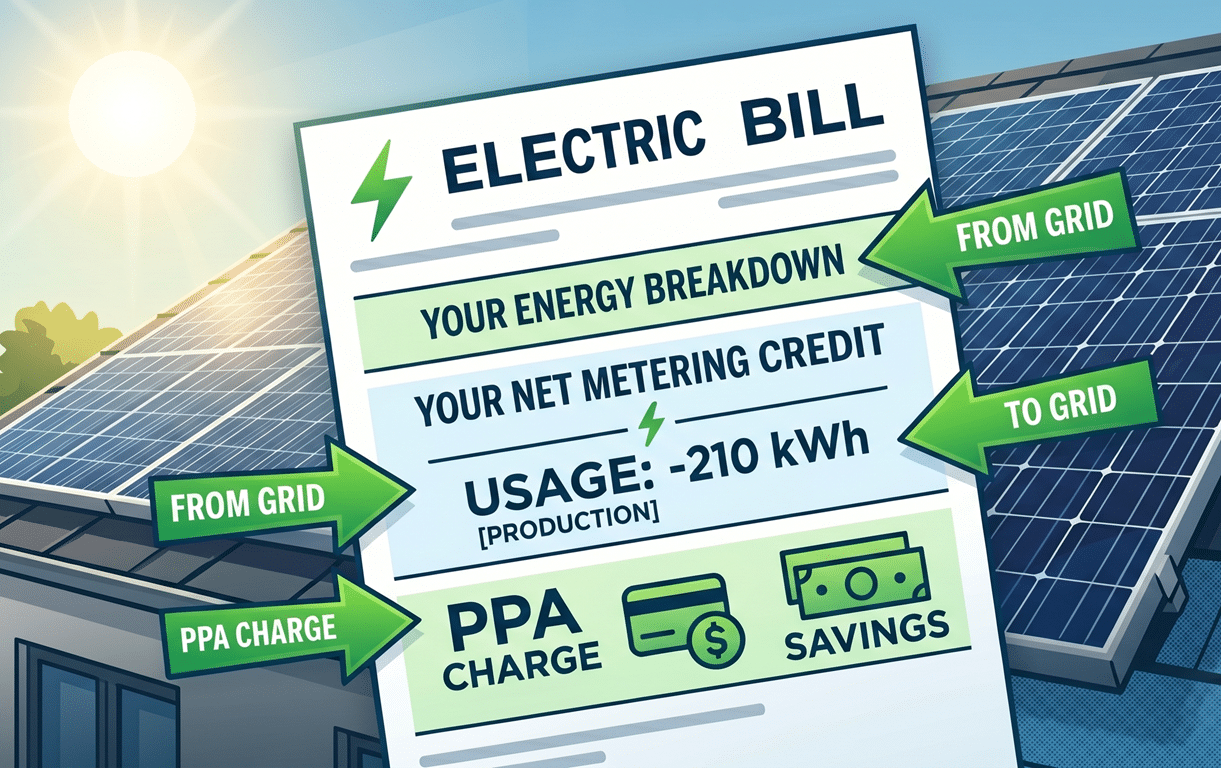
- Generation vs. Consumption: Your bill will now show two numbers: the energy you pulled from the grid and the energy you sent to the grid.
- Banked Credits: If you produced more than you used, you will see “banked” kilowatt-hours (kWh). These credits are stored and used at night or during cloudy months to offset your costs.
2. Reading Your Solar PPA or Lease Bill
Under current 2026 regulations, many homeowners in the region—especially in New Jersey—benefit from solar through a Power Purchase Agreement (PPA).
Because the direct 30% federal tax credit was eliminated for home purchases by the 2025 energy bill, the PPA has become a vital tool for energy independence. Under a PPA, a financial institution owns the system and may claim any tax benefits available to it, which can allow it to offer you a fixed electricity rate that is often lower than standard utility market rates.*
* Whether a third-party system owner can claim tax benefits, and whether any of that value reaches you, depends on current federal rules and the terms of your specific agreement. Treat any claim that a lease or PPA "still gets you the 30%" as something to confirm with your own tax professional before you sign. What matters to you is the rate you are quoted and how it compares to your utility rate.
On your bill, this looks like:
- The Utility Bill: You will still receive a bill from your utility (like PEPCO, Delmarva Power, PPL, or PSE&G), but the “Supply” or “Generation” portion should be near zero or significantly reduced.
- The PPA Invoice: You will receive a separate, predictable invoice for the solar energy produced by the panels on your roof at that lower-than-market rate.
3. Fixed Charges: Why is my bill not $0.00?
A common question we hear at SunnyMac is, “If I have solar, why do I still have a bill?” It’s important to remember that as long as you are connected to the grid for backup power, the utility charges some sort of “Customer Charge”.
These are fixed costs for maintaining the poles, wires, and infrastructure that keep your home connected. Think of it as a small subscription fee for grid reliability and stability.
4. State-Specific Nuances
Each state in our region handles solar billing slightly differently:
- New Jersey: Homeowners often see the most dramatic savings on PPAs because local utility rates are historically high compared to the fixed PPA rates enabled by 2025’s legislative provisions.
- Delaware: Look for your BBB Torch Award-winning partner, SunnyMac, to help explain the specific “Renewable Energy Credit” sections often found on Delmarva Power statements.
- Maryland & Pennsylvania: These states have robust net metering programs where banked credits typically roll over monthly, helping you build a “buffer” for the winter months.
Frequently Asked Questions (FAQ)
What is a “Negative” Balance?
If you see a negative number in the “Usage” section, congratulations! That means you produced more energy than you consumed during that billing cycle. Those credits will usually sit in your “account bucket” for future use.
Why is my bill higher in the winter?
Solar production is naturally lower during the shorter days of winter. However, the credits you banked during the sunny summer months are designed to offset this seasonal dip, providing long-term home comfort and financial stability.
Who do I call if my bill looks wrong?
First, check your solar monitoring app (like SolarEdge) to ensure your system is active. If the production matches but the utility bill seems high, contact SunnyMac. We view every customer as a long-term partner and are here to help you navigate utility disputes.
Conclusion: Taking Control of Your Energy Future
Understanding your bill is the final step in mastering your home’s energy story. By combining solar production with high-efficiency HVAC and a durable roof, you aren’t just saving money—you’re building a more resilient, sustainable home.
Ready to see how much you could save with a fixed-rate PPA?